
Beaufort County Release Records
Release from Beaufort County Detention Center means that the Sheriff's Office ended that particular period of local confinement. The person normally disappears from the app-based current inmate search after local custody ends. That change alone does not reveal the destination. Someone may walk out after bond, a court order, dismissal, or completion of a local term. Another person may leave the building in the custody of the North Carolina Department of Adult Correction, another county, a federal authority, or immigration officials.
The agency that completes the movement owns the most direct record. The Beaufort County Sheriff's Office can confirm a local discharge or transfer. The court file explains a dismissal, judgment, sentence, or release order. NCDAC records a state-prison admission, actual release, and later supervision. Federal Bureau of Prisons and ICE tools apply only when those systems took custody. A record should be read as evidence of one agency's event, not as a promise that no other authority remained involved.
- Discharge
- The end of custody under the agency named in the record.
- Time served
- Release after the custodial term or credited term is complete.
- Transfer
- A move between custodians, not a community release.
- Post-release supervision
- Community supervision that follows many current North Carolina felony prison terms.
How Beaufort Inmates Leave Custody
The recorded disposition determines what should be checked next. Bail initiation in the official sheriff app is not proof that discharge finished. Staff may still need to process the bond, confirm a court order, or resolve another hold. Likewise, a person sent to NCDAC has left the county facility but remains incarcerated. The following distinctions prevent a roster change from becoming an unsupported release claim.
| Departure type | Meaning | Best next record |
|---|---|---|
| Bond or court order | Local pretrial custody ends after legal and administrative requirements are met. | Sheriff release record plus the eCourts bond or order entry. |
| Dismissal | The charge may end, subject to any other case or hold. | eCourts disposition and local discharge confirmation. |
| Time served or expiration | A local custodial term has been completed. | Commitment, judgment, and actual jail release record. |
| State transfer | NCDAC takes custody after a state sentence or other authorized move. | NCDAC offender locator, not a county released list. |
| Other authority | Another county, USMS, BOP, or ICE may receive the person. | Receiving agency record and the sheriff's transfer disposition. |
| Supervised release | Physical custody ends while parole or post-release conditions begin. | NCDAC incarceration and supervision status fields. |
What Beaufort Release Records Show
The sheriff does not publish a field schema for its jail release record. A narrow request should name the existing items needed rather than assume every field exists. Identity and booking details connect the discharge to the right person. Time and disposition fields answer when the local custody event ended and whether the person entered another system. A receiving-agency field, when maintained, is especially important because it distinguishes a transfer from departure into the community.
| Requested field | What it can establish |
|---|---|
| Booked name and birth date | Identity match for people with similar names. |
| Booking number | Connection to one Beaufort County detention episode. |
| Admission date and time | Start of the period being researched. |
| Actual release date and time | When local discharge processing was completed. |
| Release disposition or type | Bond, order, time served, transfer, or another recorded outcome. |
| Receiving agency or destination | Whether another authority took custody, if the jail records it. |
| Booking photograph | The discrete identification image, requested as a separate record. |
NCDAC uses a different record. A released state record can preserve a photograph, sentence history, conviction county, minimum and maximum terms, Actual Release Date, and the separate Projected Release Date. Its header distinguishes inmate status from probation, parole, or post-release status. A court record instead provides the legal event. The event date may precede the time jail staff completed the physical discharge.
Request Beaufort County Release Records
No dedicated online jail-release request form was found. The sheriff's incident-report request asks for incident details and is not labeled for release records or booking photographs. Direct a focused Chapter 132 request to the Sheriff's Office records custodian. Ask for records that already exist; the Public Records Act does not require staff to create a new explanation or answer a set of questions.
- Gather the full name, birth date, approximate booking date, and booking number if known.
- Contact the Beaufort County Sheriff's Office at 210 N. Market Street, Washington, NC 27889, 252-946-7111, or info@co.beaufort.nc.us.
- Request the booking and release record, including actual release time, disposition, and receiving agency if maintained. Request the booking photograph separately.
- Ask for electronic inspection or delivery first. Request a cost estimate before paper copying or extensive retrieval.
- If information is withheld, ask for the nonexempt portion and the legal basis for the denial.
G.S. 132-6 requires access at reasonable times and copies as promptly as possible, but it sets no fixed response period. G.S. 132-6.2 limits ordinary uncertified copy charges to actual reproduction cost and permits a reasonable special-service charge for unusually demanding requests. Beaufort County publishes no guaranteed jail-release turnaround or universal copy price, so neither should be assumed.
For the judgment, disposition, or release order, ask the Beaufort County Clerk of Superior Court. NCDAC should receive only requests about state prison or state supervision. It explicitly does not hold Beaufort County jail records.
Beaufort Release Law and Retention
North Carolina General Statutes Chapter 132 broadly defines public records, while G.S. 132-1.4 excludes criminal-investigation and intelligence material from ordinary access and still makes specified arrest facts public. Juvenile, sealed, expunged, medical, and other protected information remains restricted. NCDAC also treats much of an internal correctional file as confidential while identifying core conviction, sentence, admission, time-served, and release dates as generally public.
The local-government retention schedule is not an app display policy. It authorizes different retention periods by record class. Identification photographs outside a case file are generally scheduled for three years, many misdemeanor case files for three years after disposition and appeals, and solved felony case files for twenty years after disposition and appeals. Holds for litigation, audit, or investigation may extend retention, and the local agency must adopt and apply the schedule.
An expunction follows a specific North Carolina statute and qualifying process. It can restrict or remove covered state court and arrest records as the order directs. It is not a general request to erase every private copy, and a missing Portal result may reflect sealing or another access restriction. The clerk can explain filing mechanics but cannot decide eligibility or give legal advice.
Beaufort Releases in eCourts
Beaufort County participates in the statewide eCourts system. After the jail app stops showing current custody, Portal Smart Search can preserve the legal timeline through Case Summary and Register of Actions entries. Search criminal actions, narrow to Beaufort County or District 2, and compare the name with a birth date or case number. Look for a disposition, judgment, bond change, sentence, or release order.
The court event answers why the legal status changed. It does not necessarily show the minute the person walked out, and another hold can prevent discharge. Pair it with the sheriff's actual release record. When Portal is incomplete or restricted, use a public terminal or request the paper file from the Beaufort County Clerk, 112 W. Second Street, Washington, at 252-940-4000. The sheriff FAQ routes court records to that clerk and warrant questions to the magistrate at 252-940-4019.
The official eCourts entry point shows where Beaufort County criminal case events are searched.
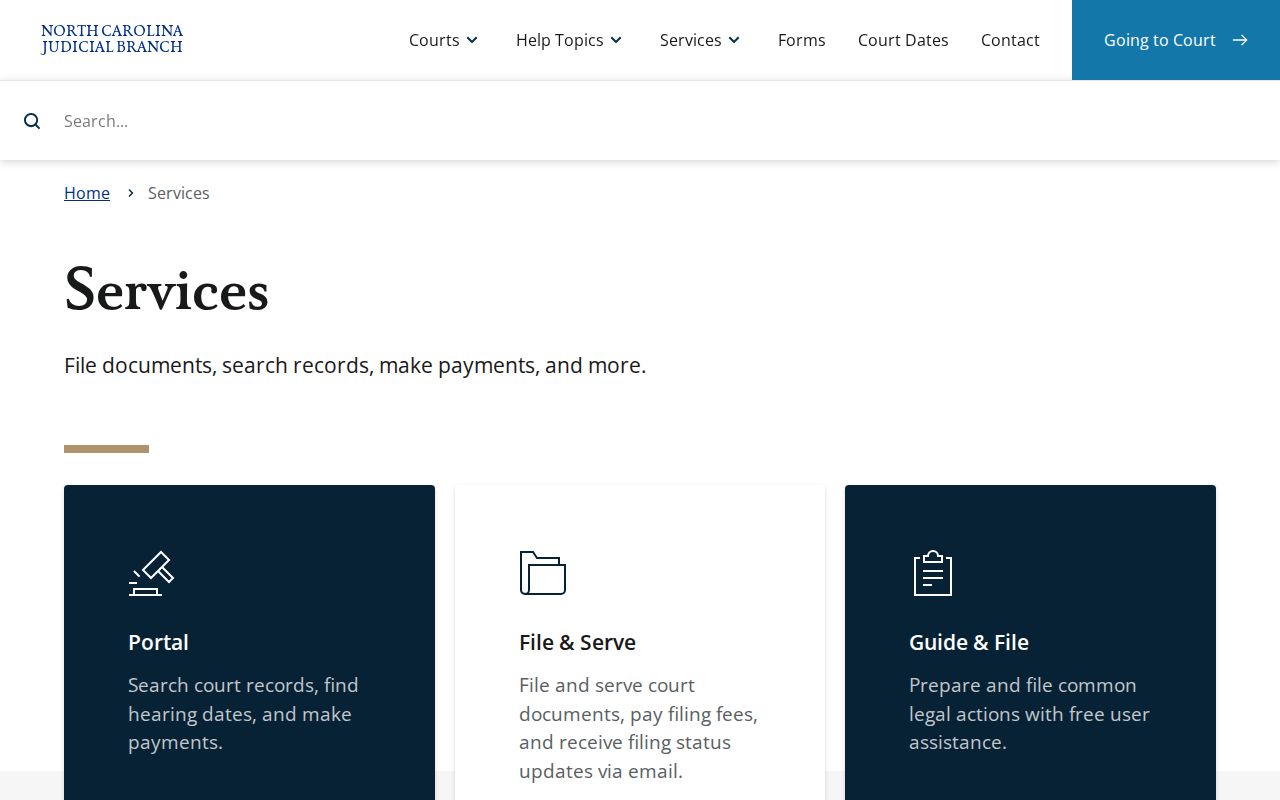
This court channel should support, not replace, the custody record from the agency that held the person.
Find Released Beaufort County Inmates
Begin with the institution that last held the person. A broad web search can mix Beaufort County, North Carolina with the same-named county in South Carolina. The North Carolina sheriff domain is beaufortcountysheriff.org, the county seat is Washington, and local telephone numbers use area code 252. Once the correct county is fixed, follow the custody trail rather than assuming every database covers the same people.
- Check the official Beaufort County Sheriff NC app to see whether the person remains in current local custody.
- If absent, call detention at 252-946-7111 or 252-946-7113. Ask whether the outcome was community discharge, transfer, or another hold, and request the existing release record.
- Use eCourts to find the legal event behind the change, such as bond, dismissal, judgment, or a release order.
- Search NCDAC if a state sentence, state transfer, parole, probation, or post-release supervision is possible.
- Use NC SAVAN/VINELink for a custody-event notice. Verify its contributing agency and confirm the event with that source.
- Search BOP or ICE only when federal or immigration custody is a real possibility.
The county publishes no verified browser-based recent-release feed. The Beaufort County 24-hour release process therefore uses the same direct confirmation chain rather than presenting a made-up list. When name searches fail, switch to a booking number, NCDAC offender number, court case number, BOP register number, or immigration A-number.
NCDAC Beaufort Release Search
The NCDAC Offender Public Information Search covers current and historical state prison, probation, and parole information back to 1972. It contains no county-jail-only data. Choose Inactive for a known former state prisoner or All when the current state status is uncertain. A seven-digit offender number is the strongest key. Name searches can be narrowed with birth date, age, and other identity fields.
| Search field | Use |
|---|---|
| Offender status | All, Active Inmate, Active Probationer/Parolee, or Inactive. |
| Name and Sounds Like | Find possible matches when spelling varies. |
| Seven-digit offender number | Open the most precise state record. |
| Birth date or age range | Separate people who share a name. |
| Inmate status | Read physical state-prison custody. |
| Supervision status | Check probation, parole, or post-release status separately. |
| Actual and projected dates | Distinguish a completed event from a changing estimate. |
North Carolina also provides an Inmate Release Search by available month, year, release county, or name. Its results include offender number, release date, primary offense, and release type. Choosing Beaufort does not turn it into a Beaufort County Detention Center list. It is a state-prison release tool.
The official locator form illustrates the state fields and the inactive-status route.
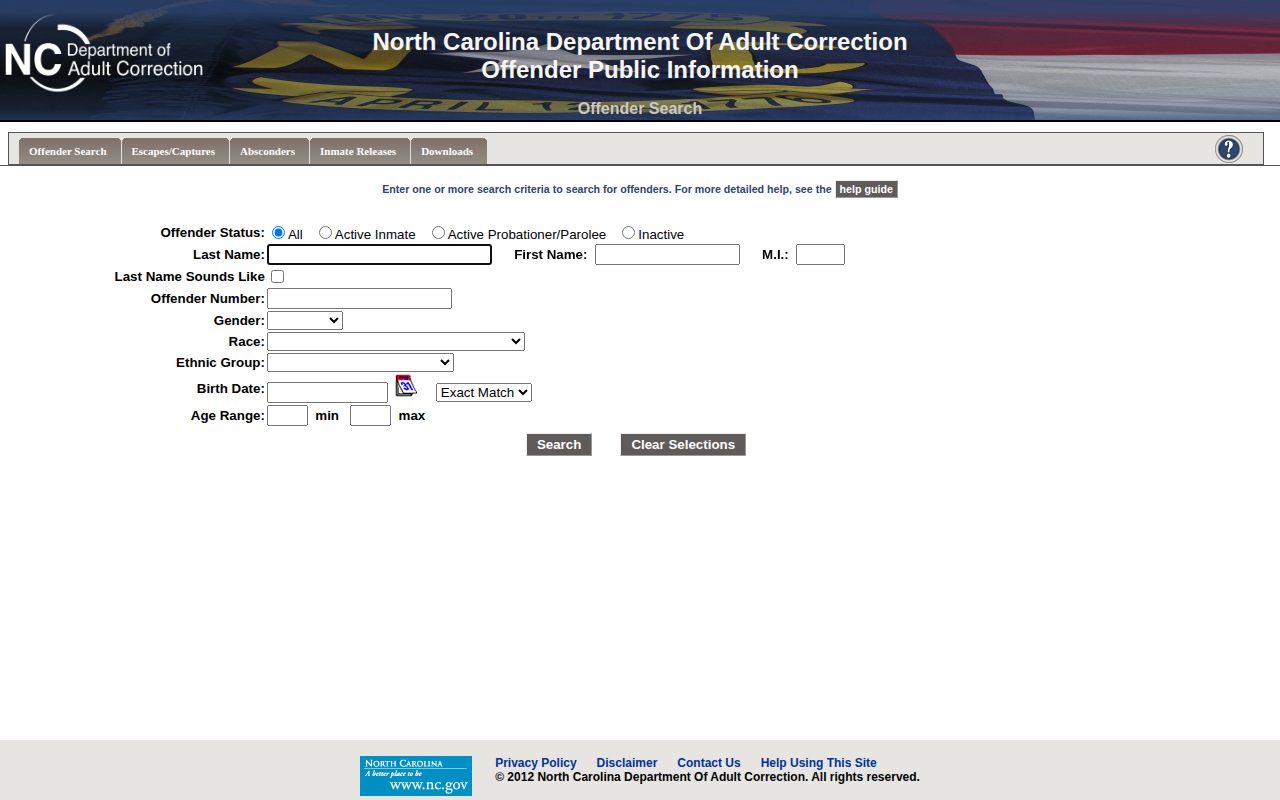
Open the linked offender number and compare identity, actual release, and supervision rather than relying on the result name alone.
Beaufort Supervision After Release
Physical release can begin a second public status. Probation is court-ordered community supervision and does not itself prove a prison discharge. Parole is discretionary release used mainly for older North Carolina sentences and limited exceptions. Post-release supervision is the mandatory supervised portion that follows many current Structured Sentencing felony terms. The NCDAC locator displays the supervision line separately from inmate status, so both must be read.
The Community Supervision Judicial District 2 office at 1308 Highland Drive, Suite 102, Washington, serves Beaufort and four neighboring counties. Beaufort parole and probation records come from the locator, absconder search, and Commission records. An absconded status means NCDAC reports avoidance of supervision; it is not a new release entry or a complete warrant search.
Beaufort Reentry Help After Release
Two local resources address needs after release without serving as custody databases. A New Direction Local Reentry Council serves Beaufort, Hyde, Martin, Tyrrell, and Washington counties from Washington. NCDAC also publishes a Beaufort County resource packet. Use them for navigation after status is confirmed, not as evidence that release occurred.
The distinction matters when reconnecting with someone. Reentry staff can help navigate post-release needs, but they do not own the Beaufort County jail record, the court disposition, or the NCDAC status entry. Confirm the custody event first, then use the local resources for their intended support role.
Beaufort Release Alerts and Transfers
NC SAVAN/VINELink supports specific-person searches and custody-event registration by web, app, or 1-877-627-2826. The service can carry county jail, state prison, probation, parole, and post-release events. A result belongs to the contributing agency. It is a notification layer, not the owner of the underlying sheriff, court, or NCDAC record, and a missing result does not prove release.
Federal custody requires a separate route. The BOP Inmate Locator covers federal inmates from 1982 forward and may show Released or Not in BOP Custody with a date. That status does not exclude supervised release or another custodian. The U.S. Marshals Service may also move a federal pretrial prisoner without providing a public historical release locator.
Beaufort ICE Transfers After Release
The ICE locator uses an exact A-number and country of birth, or exact name and country of birth, and includes current detention plus some releases within the prior sixty days. An exact identity check is important because the system answers an immigration-custody question, not a general Beaufort County release question.
No official evidence places an ICE detention facility or current 287(g) program in Beaufort County, North Carolina. If the sheriff record indicates an immigration or federal hold, describe the local departure as a possible transfer until the receiving system confirms otherwise. A move from the local jail into immigration detention is not community release.
Beaufort Custody Versus Release
Each system answers a narrow question. Using the live jail search as a historical list, or using NCDAC for a local-only booking, produces false conclusions. Match the source to the custody that ended.
| Source | Still in custody | After release or transfer |
|---|---|---|
| Sheriff mobile app | Current Beaufort jail listing. | Visibility and historical fields are not verified; call detention. |
| Sheriff release record | Not a live roster. | Best local actual date, disposition, and possible destination. |
| eCourts Portal | Case activity, not physical custody. | Disposition, judgment, bond, and order history. |
| NCDAC locator | State prison and active supervision. | Inactive history, Actual Release Date, and supervision status. |
| VINELink | Agency-supplied custody event. | Agency-supplied release alert that still needs source confirmation. |
| BOP or ICE | Federal or immigration custody only. | System-specific release or not-in-custody information. |
Beaufort County Detention Center
The Facility Map identifies one local detention facility: the Beaufort County Detention Center, a direct-supervision county jail operated by the Sheriff's Office in the courthouse basement. It primarily holds pretrial detainees and people serving shorter local terms. The current sheriff page states eighty-five beds.
A local exit may lead to the community after bond, court action, dismissal, or completion of a sentence. It may instead lead to NCDAC, another county, USMS/BOP, or ICE. No municipal jail, NCDAC prison, federal prison, or ICE detention facility was located within Beaufort County. Call the facility to identify an unverified destination rather than importing records from another county or state.