
Beaufort County Release Date Meaning
A projected release date is a working calculation based on the judgment, credited jail time, the law that governs the sentence, concurrent or consecutive terms, earned credits, and current custody status. It is most useful for a sentenced person. North Carolina Department of Adult Correction records use the exact label Projected Release Date. When a person has already left state prison, the same record may preserve a separate Actual Release Date. The first field looks ahead. The second records a completed departure from NCDAC custody.
The distinction is vital in Beaufort County. A court's maximum sentence is not a substitute for the current corrections calculation. Nor does a court order always state the hour when discharge processing ends. A release order may be followed by identity checks, property return, or review of another hold. A transfer also ends custody at one site without releasing the person to the community.
Note: A person missing from the Beaufort County jail app may have transferred, so absence alone never confirms an actual release.
Which Beaufort County Release Clock Applies?
Start with the custody that is expected to end. Beaufort County Detention Center holds many people before trial as well as people serving shorter local terms. Those groups do not share one release-date rule. The sheriff's detention services page routes current inmate and bail access to its mobile app, but the bail path is not a date calculator. A bond can be arranged while discharge is still blocked by another case or hold.
| Custody situation | Best date source | What the date means |
|---|---|---|
| Pretrial detention | Court event plus detention confirmation | Often no fixed date; bond, dismissal, a release order, and holds control departure. |
| Local jail sentence | Judgment, credited time, and the jail's current calculation | The expected end of the local term after lawful credits and any other commitments. |
| NCDAC prison sentence | NCDAC offender detail | A computed state-prison date under the controlling sentence and credit rules. |
| Older parole-eligible case | NCDAC record and Parole Commission action | A projection that may change if parole is granted, denied, or reviewed again. |
| Transfer or detainer | Both sending and receiving agencies | The end of one custody may begin another rather than lead to community release. |
A sentenced state prisoner may once have passed through Beaufort County Detention Center, yet NCDAC owns the later prison calculation. By contrast, NCDAC expressly does not hold county-jail-only records. Keep both systems separate.
Find a Beaufort County Projected Release
The strongest lookup uses an identifier and then checks the right custodian. A seven-digit NCDAC offender number is better than a broad name match. For a county booking, a booking number and date help the jail distinguish people with similar names. The full released-person path is also available from the Beaufort County released-inmate search.
- Decide whether the person is pretrial, serving a Beaufort County jail term, or serving a North Carolina prison sentence.
- For current local custody, use the official sheriff app, then call detention if the expected date is not shown or needs confirmation.
- For a local sentence, obtain the court judgment and credited-time information, then ask detention for its existing calculated release date.
- For state custody, open the NCDAC Offender Public Information Search. Choose All if status is uncertain, or Inactive for a former state prisoner.
- Open the linked offender number, verify birth and conviction details, and compare Inmate Status with Probation/Parole/Post Release Status.
- Read the most recent incarceration and sentence blocks for Projected Release Date, Actual Release Date, sentence status, minimum and maximum terms, and supervision.
- Confirm a near-term departure with the jail or NCDAC. Check the receiving agency if a detainer or transfer appears possible.
NCDAC's detail can show both inactive prison status and active supervision history. That means the person may have left prison but not completed the sentence. It also means a projected prison departure and the end of post-release supervision are two different dates.
The official NCDAC search screen shows the status and identity filters used to reach the detailed record.
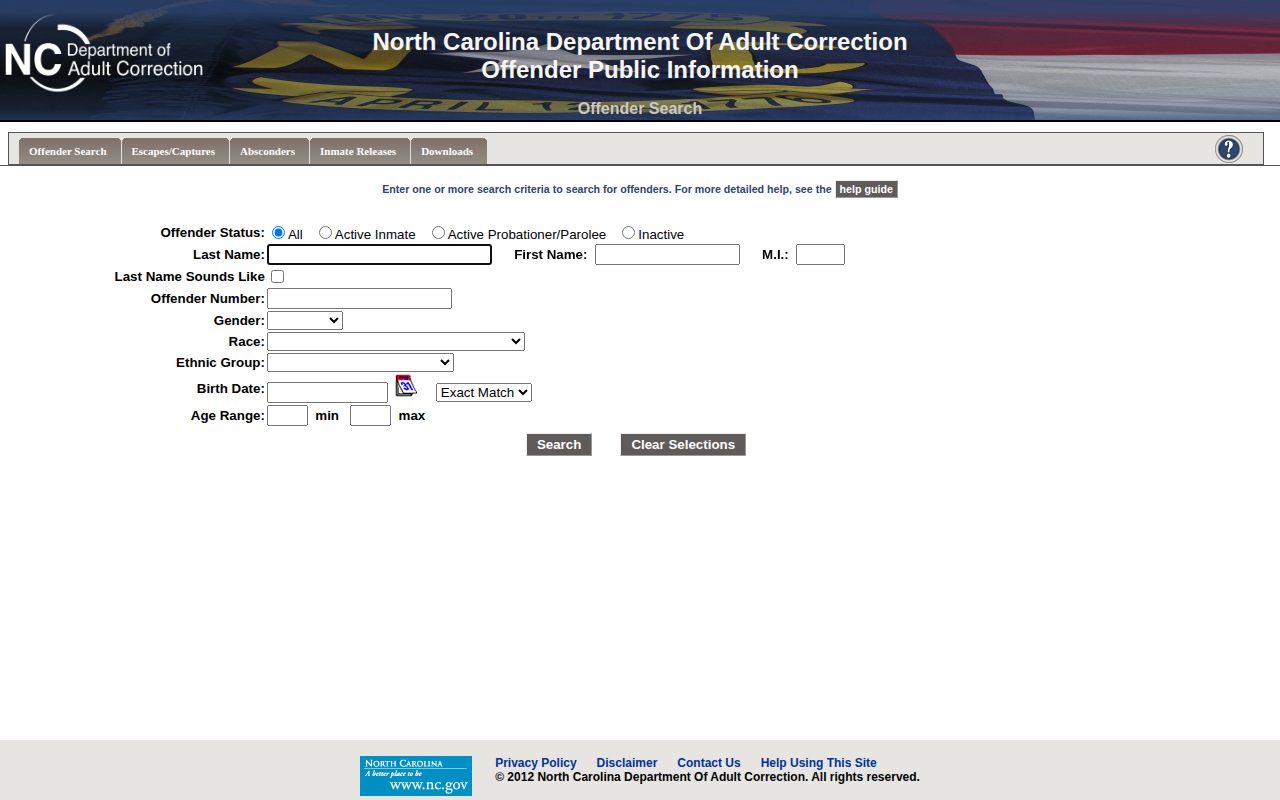
The public form is a state prison and supervision search, not a Beaufort County jail roster.
Note: Use name, birth data, and conviction details together before relying on any Beaufort County release-date match.
North Carolina Release-Date Math
North Carolina's Structured Sentencing framework does not create a simple statewide percentage that can be applied to each person. Under G.S. 15A-1340.13(d), a person serving an active felony term must serve the judicial minimum. Earned time can reduce the maximum term, but it cannot move the date below that minimum. NCDAC describes the grid relationship as service of the full minimum, with the minimum commonly equal to 85 percent of the maximum, followed by post-release supervision.
That explanation is qualified. It is not a universal 85 percent rule. Offense date, class, sentence type, judgment, and special law control. Older Fair Sentencing cases, DWI terms, local jail sentences, life terms, consecutive commitments, and revocations can work differently. A sound Beaufort County projected release date therefore comes from the live record, not multiplication performed from a sentence shown in a news story or docket.
For many current felony terms, release from prison begins a mandatory supervised part of the sentence. North Carolina law generally calculates that transition from the maximum term after earned time, with different supervised portions for offense classes and certain reportable convictions. As a result, the projected prison-release date can arrive before sentence termination. Beaufort County families should compare the inmate-status line with the separate probation, parole, or post-release status. One tells whether NCDAC still holds the person in prison. The other can show whether NCDAC still supervises the person in the community.
Beaufort County Earned-Time Limits
For a Structured Sentencing offender, NCDAC says a qualifying job or full-time program can earn credit. Changes in work, programs, transfers, or discipline can alter the credit balance. Older Fair Sentencing cases can involve gain time for work or programs, good time for behavior, and merit time in qualifying settings. Misdemeanor terms have a parallel earned-time rule, while DWI and older-law cases may have special provisions.
G.S. 148-13 directs NCDAC to set rates and conditions for earned-time credits. Its local-jail provision requires those rules to be distributed to and followed by jail administrators for sentenced jail prisoners. The statute does not supply a Beaufort-specific numeric rate, and the research found no official local credit table. For a person serving a term at Beaufort County Detention Center, the proper route is the judgment, credited time, and detention's current calculation.
This local limit is easy to miss. A state credit description cannot be turned into a guessed number of days for a county sentence. Ask for the existing commitment or release record. If the calculation is disputed, the judgment and custodian's record are more useful than a generic online estimate.
Pretrial credit adds another layer. Time spent in Beaufort County custody before judgment may be credited to the active term, but the signed judgment and the custodian's calculation control how it is applied. Concurrent sentences may run at the same time, while consecutive terms follow one another. A revocation can activate or change confinement. Before estimating a Beaufort County release date, identify each commitment, its start point, its relationship to the others, and any credit the court recognized.
Note: No published Beaufort County credit rate supports a homemade release-date calculation for a locally sentenced person.
What Changes Beaufort County Release Dates?
A projected date is recalculated when a fact that feeds the sentence changes. Some events move it earlier. Others delay departure or cause the person to enter a second custody after the first term ends. The public field may lag a new order, so a near-term date deserves direct confirmation.
| Factor | Possible effect | Where to verify |
|---|---|---|
| Earned, good, or merit time | Moves an eligible calculation toward the lawful minimum. | NCDAC record or local custodian. |
| Discipline or program change | Credits may be lost, paused, or recalculated. | NCDAC current calculation. |
| Jail credit | Credited pretrial time may alter time left to serve. | Court judgment and custodian. |
| Concurrent or consecutive terms | Changes how multiple commitments overlap or follow each other. | Sentence detail and judgment. |
| Vacatur or resentencing | A later court order can shorten, replace, or end a term. | eCourts file and corrected custody record. |
| Detainer, hold, or new case | The calculated term may end while another authority keeps custody. | Sending jail plus receiving agency. |
| Parole or commutation | An eligible older-law case can receive a different release path. | NCDAC and the responsible commission. |
North Carolina law also links many current felony prison releases to mandatory post-release supervision. Release from prison can occur before the entire sentence terminates. The supervision field must therefore be read beside the inmate status rather than treated as an afterthought.
Confirm a Beaufort County Release Date
Use the agency with physical custody for final confirmation. For Beaufort County Detention Center, call the main line at 252-946-7111 or the detention contact at 252-946-7113. Ask whether the date is calculated, court-ordered, or already actual. Also ask whether the outcome is community release or transfer. The front office at 210 N. Market Street in Washington is open Monday through Friday from 8 a.m. to 5 p.m.
If the date depends on a court event, begin at the official North Carolina eCourts services entry, then narrow Smart Search to Beaufort County or District 2. Review the disposition, judgment, bond event, or release order. The court event explains the legal basis, while detention confirms when physical processing ended.
For state custody, verify through NCDAC and use notification as a supplement. A VINELink release check can provide a custody-event alert, but the supplying agency remains the source for the final status. If a federal or immigration hold is involved, BOP or ICE must be checked separately because neither NCDAC nor the county jail can prove release from those systems.
When no public field answers the question, request the existing Beaufort County commitment and release record with the full name, birth date, booking date, and booking number if known. Ask for the calculated or actual release date, the recorded release type, and the receiving agency when a transfer occurred. No published Beaufort County release-record fee or guaranteed turnaround was found. Request electronic inspection first, narrow the date range, and ask for an estimate before any charge is incurred.