
Compare Beaufort Parole and Probation
North Carolina uses parole, probation, and post-release supervision for different forms of community control. Probation is ordered by a court. It often replaces an active prison term or follows the plan in a judgment. Parole is discretionary early release and now applies mainly to older cases for offenses committed before October 1, 1994, plus narrow exceptions set by law. Post-release supervision is the required community portion of many current Structured Sentencing felony terms. A person can be out of prison yet still have an active state supervision record.
The distinction affects where to verify the status. NCDAC, the North Carolina Department of Adult Correction, maintains prison and community-supervision history. The court file explains the judgment that imposed probation. The Post-Release Supervision and Parole Commission handles parole decisions in eligible older-law cases and sets conditions for post-release supervision, but a statutory post-release date is not a discretionary parole grant.
| Supervision type | How it begins | Best official record |
|---|---|---|
| Probation | A court orders community supervision, often instead of active imprisonment. | NCDAC supervision status plus the Beaufort County court judgment. |
| Parole | The Commission approves release in an eligible older-law or special case. | NCDAC history and the Commission's review records. |
| Post-release supervision | State law places a sentenced person on supervision after prison. | NCDAC prison and post-release status fields. |
- Discharge
- The formal end of a custody or supervision term.
- Revocation
- An order ending community supervision and returning the person to confinement for a violation.
- Absconder
- A person whom NCDAC reports as avoiding required supervision contact.
- Detainer
- A request or hold from another authority that may affect custody or release.
Verify Beaufort Post-Release Supervision
The official NCDAC Offender Public Information Search is the main public lookup for state probation, parole, and post-release supervision. It also carries prison history dating back to 1972. It does not contain Beaufort County jail-only records. For a person who only left the Beaufort County Detention Center and never entered the state system, detention records and the court file remain the proper sources.
- Choose Active Probationer/Parolee when active supervision is expected. Choose All when the current status is unclear.
- Enter the seven-digit NCDAC offender number when known. Otherwise combine the name with birth date or age to narrow the match.
- Open the linked offender number. Compare birth date, conviction county, and sentence details before treating it as the right person.
- Read both Inmate Status and Probation/Parole/Post Release Status. They answer different questions.
- Review the current location and supervision periods. Then contact the listed office if an assignment or reporting instruction needs direct confirmation.
An inactive prison status does not always mean the whole sentence is over. Active post-release supervision may begin as soon as physical prison custody ends. Conversely, an inactive community-supervision status does not rule out a local warrant, a new jail booking, or custody held by another state or federal agency. For the release event itself, follow the county and state paths on the Beaufort County released-inmate search.
Note: Match more than a name, since shared names and changed names can produce a false supervision result.
Beaufort Supervision Search Fields
The NCDAC form offers more than a basic name box. Its status choices include All, Active Inmate, Active Probationer/Parolee, and Inactive. Searchers can enter first and last name, a middle initial, or use the “Last Name Sounds Like” option when spelling is uncertain. The form also accepts the offender number, birth date with a selected age range, gender, race, ethnic group, and an age range. Extra filters should distinguish likely matches, not replace identity checks on the result.
| Field | Use in a Beaufort supervision check |
|---|---|
| Offender Status | Select Active Probationer/Parolee for a narrow active search, or All when prison and supervision status are uncertain. |
| Offender Number | Use the seven-digit NCDAC number for the most precise search. |
| Name and Sounds Like | Search a known spelling first, then broaden only when needed. |
| Birth Date or Age | Separate people with the same or similar names. |
| Status Lines | Compare prison custody with probation, parole, or post-release status. |
| Supervision Periods | Check start, end, location, and whether NCDAC reports the period as active. |
A public result may include old periods as well as the current one. Read dates and service status in context. Basic conviction, sentence, time-served, admission, and release data are generally public, while many internal correctional records remain confidential under North Carolina law. An office may confirm assignment without disclosing every detail of a case plan.
Contact Beaufort Supervision District
The NCDAC Community Supervision directory places Beaufort County in Judicial District 2. That district also covers Hyde, Martin, Tyrrell, and Washington counties. The Washington office can help verify which office has an assignment or clarify reporting instructions. Staff may limit what they disclose when supervision information is confidential.
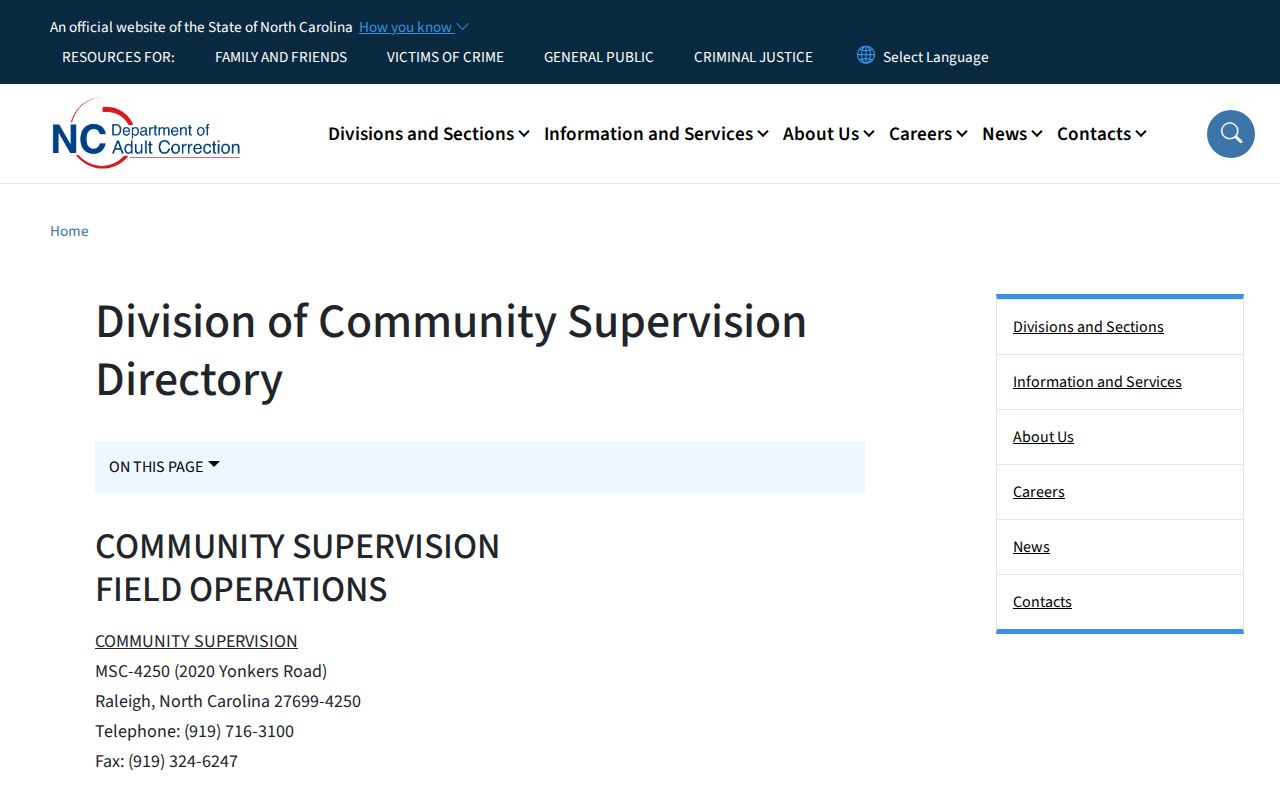
The captured directory confirms the local district route, which is more useful than calling an unrelated prison or the county jail about state supervision.
Community Supervision, Judicial District 2
1308 Highland Drive, Suite 102
Washington, NC 27889
252-946-5199
Fax: 252-946-3083
Post-Release Supervision and Parole Commission
2020 Yonkers Road
Raleigh, NC
Mail: 4222 Mail Service Center
Raleigh, NC 27699-4222
919-716-3010
Parole.Commission@dac.nc.gov
These offices serve different roles. District 2 handles field supervision in and around Beaufort County. The Commission decides eligible parole matters and sets post-release conditions. Neither office is the custodian of a county-jail booking or local discharge record.
Note: Call District 2 for office assignment questions, but use the court or NCDAC record for the legal source of supervision.
Check Beaufort Absconder and Warrants
North Carolina has a separate Absconded Probationer Search. It accepts a last name, offers a sounds-like option, and can be filtered by County of Supervision. Beaufort appears as a county choice. An absconder result means NCDAC reports that the person is avoiding supervision. It does not mean the person was just released, and it is not a complete list of warrants issued in Beaufort County.
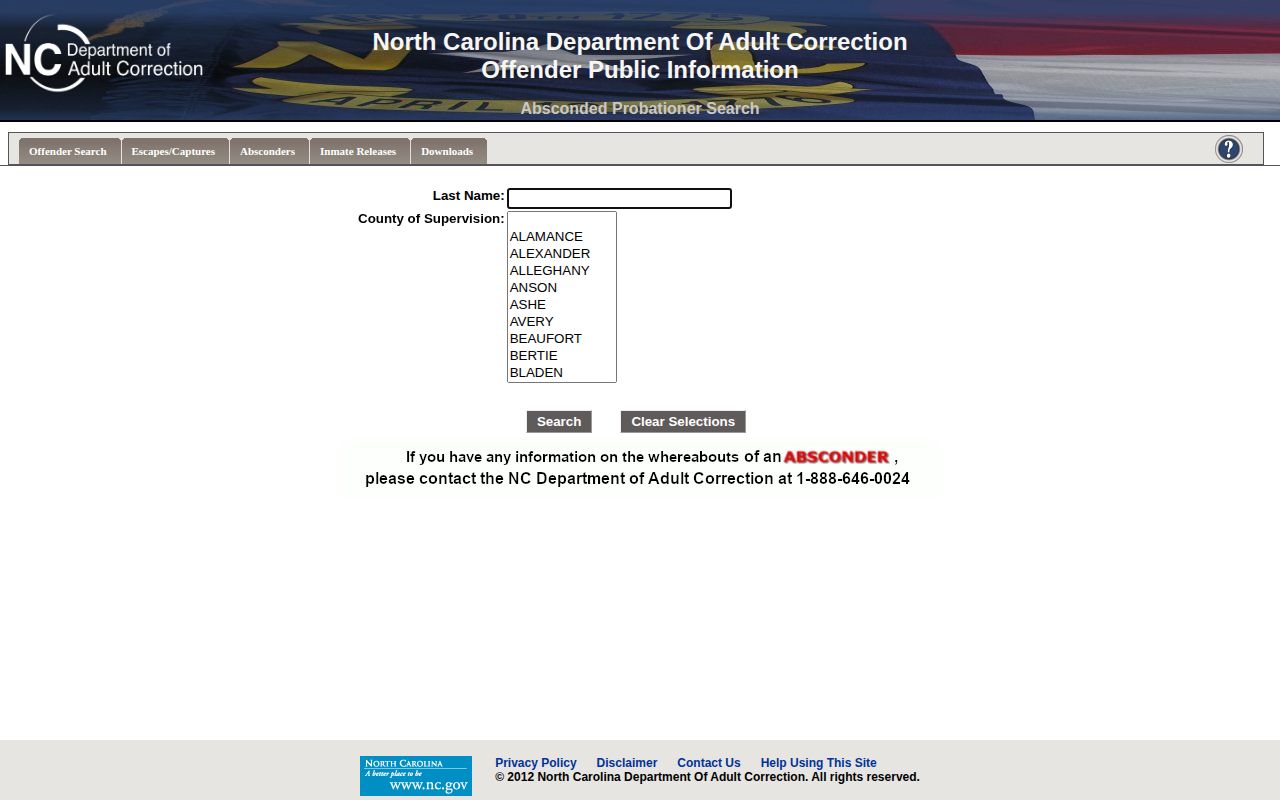
The official search image shows the county filter and name fields used for this narrow supervision question.
A warrant is a separate court or law-enforcement status. The Beaufort County Sheriff's Office FAQ directs warrant questions to the Magistrate's Office at 252-940-4019 rather than giving warrant information through the sheriff. Someone may have been released earlier and later become subject to a warrant or an alleged supervision violation. The earlier release is still a past event; the new process must be checked on its own.
NC SAVAN through VINELink can provide notices about participating probation, parole, or post-release events. A notice is not the same as a verified supervision record. Compare it with NCDAC, and use the Beaufort County court record when a warrant or judgment is part of the question.
North Carolina Parole Reviews
The North Carolina Post-Release Supervision and Parole Commission does not hold conventional formal hearings or personal meetings with offenders. Commissioners review case material and vote independently, with a majority controlling the result. There is no public hearing calendar to use for Beaufort County. That absence reflects the state's review method, not a missing county schedule.
Ordinary parole was eliminated for crimes committed on or after October 1, 1994 under Structured Sentencing. The Commission therefore deals mainly with older-law cases and limited statutory exceptions. Eligible matters are generally reviewed at least once each year. First- and second-degree murder cases are generally reviewed every three years, while sexually violent offenses are generally reviewed every two years. A narrow juvenile-lifer process may include video review, but it does not create a general public hearing system.
The official Discretionary Parole Reviews page publishes monthly named-case spreadsheets rather than a live decision search. Its labels include Regular Parole, Community Service Parole, Early Medical Release, 90-Day Mandatory Parole, Incomplete Decision, Suspend Decision, and Denied. A listed decision does not always mean immediate physical release. Confirm the actual release date and current supervision status in NCDAC.
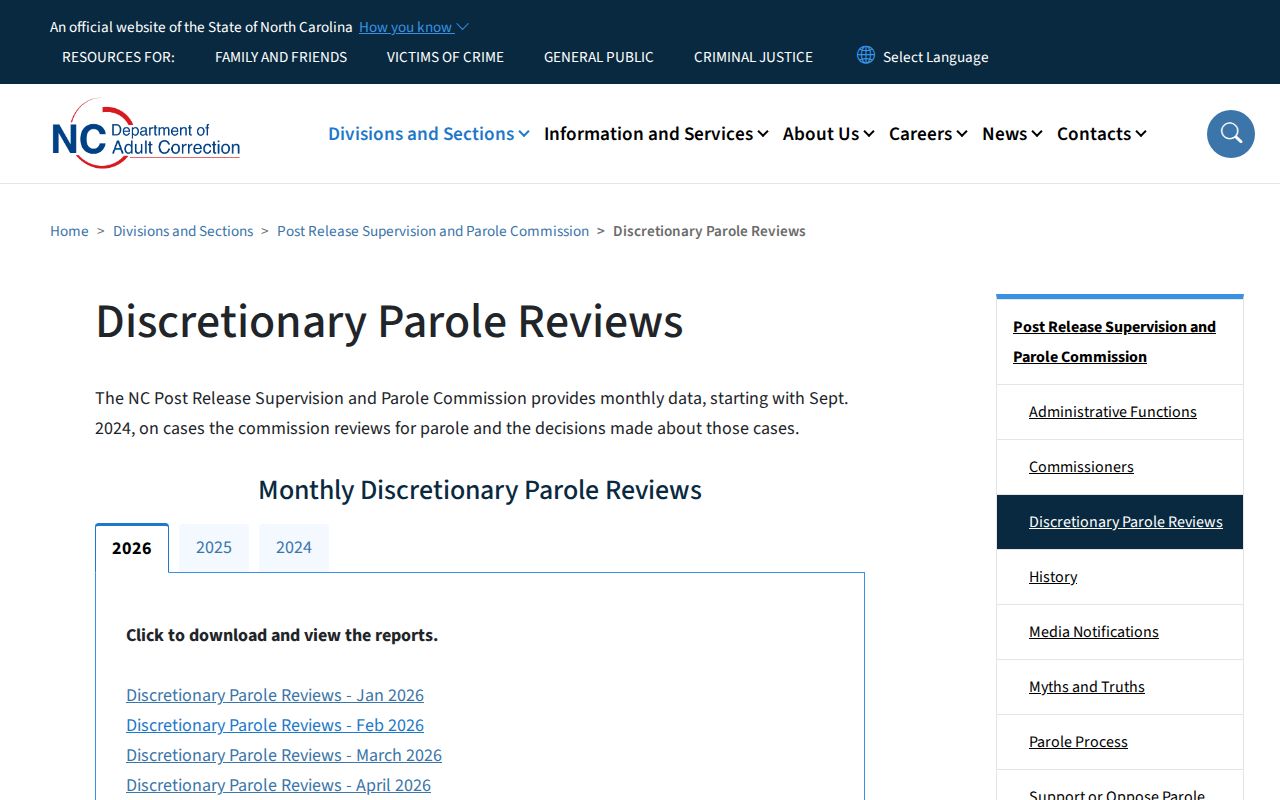
The monthly results page supplies the state's official outcome vocabulary, while G.S. 15A-1371 governs eligibility and decision grounds.
Ending Beaufort Post-Release Supervision
Supervision ends through discharge when the required term and conditions have been completed, unless another lawful action changes the case. A discharge is not the same as leaving prison. Physical release may begin post-release supervision, while discharge closes that supervision period. The NCDAC record can retain both the incarceration history and the later supervision history after each becomes inactive.
Article 84A generally places Class B1 through E felony releases at the maximum term less 12 months and Class F through I releases at the maximum less nine months, adjusted for earned time. Certain reportable-conviction terms use a 60-month rule. The linked law also sets general supervision periods of 12 months, nine months, or five years for covered cases. These rules require the person's offense date, class, judgment, and sentence details before they can be applied.
Violations can change that course. Depending on the judgment, governing statute, and official action, a response can include new conditions, other sanctions, or revocation and return to confinement. North Carolina law generally sets post-release dates and periods for current Structured Sentencing felonies. The sentence, offense date, class, earned time, and any special statute control the actual result. Broad percentage claims should not replace the person's judgment and NCDAC record.
Conditions are the binding rules set by the judgment or Commission and administered by the supervising office. A public status result does not reveal every case-plan detail. Once supervision appears inactive, compare its end date with the court file and the most recent NCDAC period. If a local case, warrant, or new booking is suspected, use that system separately. “Inactive” in the state supervision database means NCDAC does not show an active state supervision period. It does not certify that no other legal matter exists.
Note: A prison release date and a supervision discharge date mark two distinct events and may be years apart.
Beaufort Reentry After Release
Beaufort County has a local reentry layer that is separate from record verification. A New Direction Local Reentry Council serves Beaufort, Hyde, Martin, Tyrrell, and Washington counties from 417 Bridge Street in Washington. NCDAC also publishes a Beaufort County reentry resource packet. These sources can help a person navigate community services after release and while reporting to supervision.
Neither source proves custody status. A reentry referral does not show that a jail discharge finished, that a prison term ended, or that parole or probation remains active. Confirm those facts with the Beaufort County Detention Center, NCDAC, the court, or District 2 as the record requires. Reentry staff and supervision officers also have different duties. One helps connect people with services; the other administers court or state supervision conditions.
That split is useful. Records answer whether supervision exists. District 2 answers assignment and reporting questions. Local reentry sources help with the practical work that may follow release. Keeping those roles clear avoids asking a service provider to certify a legal status it does not own.